
Speed to Lead: Why a 5-Minute Delay Costs Contractors Thousands
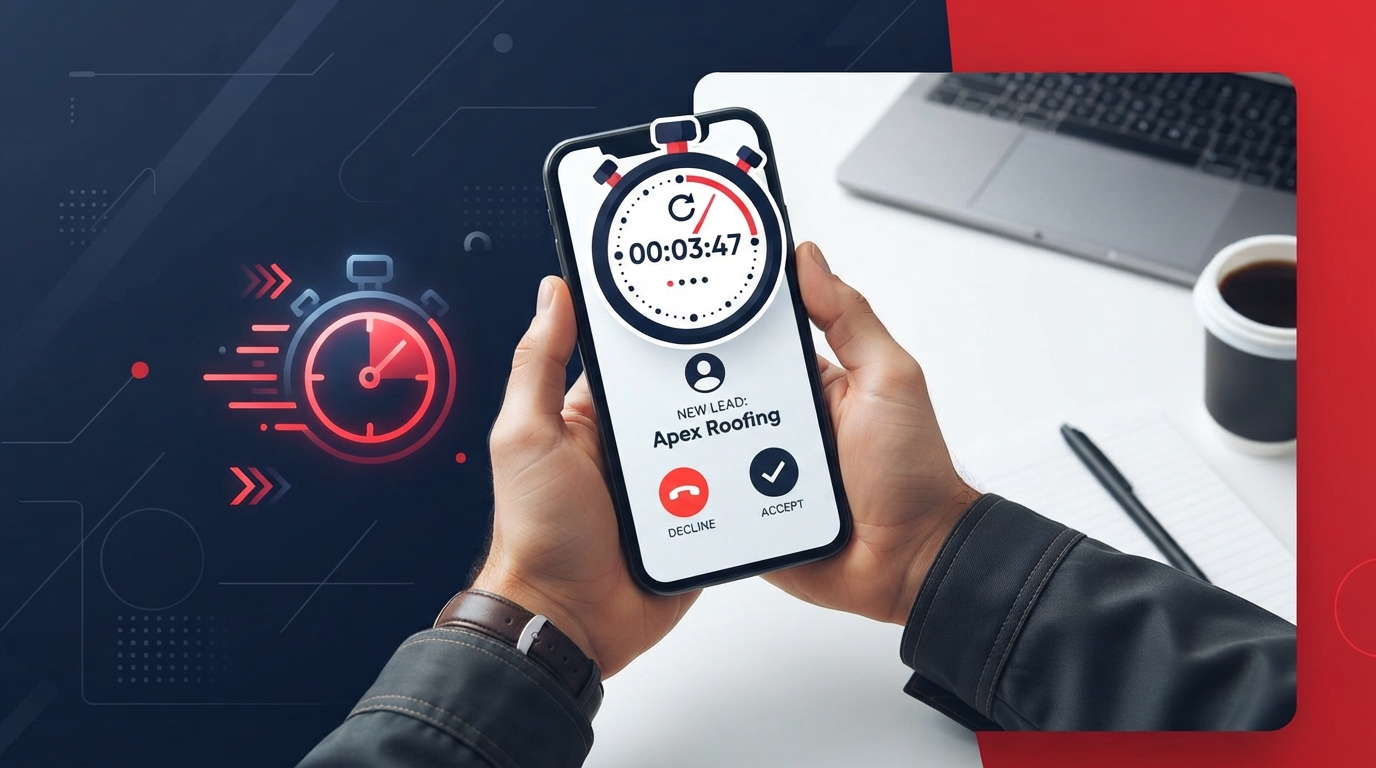
The 5-Minute Rule That Separates Winners from Losers
If a homeowner calls your business and you don't respond within 5 minutes, your odds of converting that lead drop by 80%. That's not a marketing theory — it's a well-documented statistic from multiple lead response studies. Yet most contractors take hours, sometimes days, to follow up on new inquiries.
In the home service industry, urgency is everything. A homeowner with a leaking water heater or a dead furnace isn't shopping around for fun — they need help now. The first contractor who responds professionally almost always gets the job.
Why Contractors Are Slow to Respond
It's not because you don't care. It's because you're busy. You're on a roof, under a sink, or in a crawl space. You can't stop mid-repair to answer the phone. And when you finally check your messages at 7 PM, the homeowner has already booked with the competitor who answered on the second ring.
The problem is structural: your lead response time is tied to your physical availability. As long as that's the case, you will always lose leads during peak hours and after hours.
The Cost of Slow Follow-Up
Let's put real numbers on it. Say you get 50 inbound leads a month. If your average response time is 2 hours instead of 5 minutes, you're losing roughly 30% of those leads to faster competitors. At an average job value of $4,500, that's $67,500 in lost revenue every month — over $800,000 a year.
Use our ROI Calculator to model your own numbers. The results are often staggering.
3 Ways to Achieve 5-Minute Response Times
1. Deploy an AI Receptionist
An AI Voice Receptionist answers every call on the first ring, 24/7. It qualifies the lead, collects contact information, and can even book the appointment directly onto your calendar. The homeowner feels heard immediately, and you receive a structured lead notification within seconds.
2. Automate Instant Text-Back for Missed Calls
If a call somehow slips through, an automated SMS fires within 30 seconds: "Hi, sorry we missed your call! We're on a job but want to help. What do you need?" This simple text prevents the homeowner from calling the next competitor. Pair this with automated lead follow-up sequences to nurture the lead until you can call them back personally.
3. Use Web Form Auto-Responders
When someone submits a form on your website, they should instantly receive a text and email confirming receipt and setting expectations: "Thanks for reaching out! We've received your request and will call you within 30 minutes." This buys you time while keeping the lead engaged.
The Competitive Advantage of Speed
In a market where most contractors still rely on voicemail and end-of-day callbacks, being the one who responds in under 5 minutes is a massive differentiator. It's not just about capturing more leads — it's about building a reputation as the responsive, professional company that homeowners want to work with.
When you combine speed with a CRM pipeline that tracks every interaction, you create a system where no lead is ever lost and every opportunity is maximized.
Conclusion
Speed to lead is the single highest-ROI change you can make to your business this year. Stop letting leads go cold while you're on the job site. Contact Craft Edge to build an automated response system that ensures every lead is contacted within 5 minutes — day or night.
Comprehensive Industry Analysis for 2026
As we navigate through 2026, the home service industry is experiencing unprecedented shifts. The integration of artificial intelligence, machine learning, and advanced automation tools is no longer a luxury but a necessity. Companies that fail to adopt these technologies are finding themselves outpaced by competitors who can respond faster, quote more accurately, and follow up relentlessly.
Recent market research indicates that customer expectations have evolved dramatically. Homeowners now expect Amazon-like efficiency when dealing with contractors. They want instant communication, transparent pricing, and seamless scheduling. This shift in consumer behavior means that your operational efficiency is directly tied to your brand reputation and bottom line.
Furthermore, the cost of customer acquisition continues to rise across all traditional channels. Paid advertising platforms are becoming more saturated, making each click more expensive. This economic reality forces contractors to maximize the lifetime value of every lead, emphasizing the critical importance of robust CRM systems and automated follow-up sequences.
In this hyper-competitive landscape, data is your most valuable asset. Tracking every interaction, understanding conversion rates at each stage of the funnel, and leveraging predictive analytics can provide a significant edge. By understanding the macro trends shaping the industry, contractors can position themselves proactively rather than reacting to market pressures.
Step-by-Step Implementation Guide
Implementing these strategies requires a methodical approach. It is not about overhauling your entire business overnight, but rather making strategic, incremental improvements that compound over time.
Phase 1: Audit and Assess
Begin by mapping out your current customer journey. From the moment a prospect searches for your services to the final invoice, identify every touchpoint. Where are the bottlenecks? Are leads slipping through the cracks because of delayed responses? Are estimates taking too long to generate? A thorough audit will reveal the most critical areas needing immediate attention.
Phase 2: Establish the Foundation
Before deploying advanced automation, ensure your foundational systems are solid. This means having a centralized CRM where all customer data is stored. Clean up your existing database, standardize your data entry processes, and ensure your team is trained on the core software. A system is only as good as the data it holds.
Phase 3: Deploy Automation Incrementally
Start with the highest-impact automations first. For most contractors, this is speed-to-lead. Implement automated SMS responses for missed calls and web form submissions. Once this is running smoothly, move on to automating estimate follow-ups, and finally, post-job review requests and long-term nurture campaigns.
Phase 4: Monitor, Measure, and Optimize
Automation is not a set-it-and-forget-it solution. Regularly review your analytics. Are your automated texts getting responses? Are your email open rates healthy? Use A/B testing to refine your messaging and continuously optimize your workflows for better conversion rates.
Common Pitfalls and How to Avoid Them
While the benefits of modernization are clear, the path is often fraught with challenges. Understanding these common pitfalls can save you significant time and resources.
- Over-Automating Too Quickly: Trying to automate every single process at once usually leads to confusion and broken systems. Start small, validate the process, and scale up.
- Losing the Human Touch: Automation should handle the routine tasks, but human interaction is still crucial for building trust, especially in high-ticket sales. Ensure your automated messages sound natural and always provide an easy way for the customer to speak with a real person.
- Poor Data Hygiene: If your CRM is filled with duplicate contacts, outdated information, and incorrect formatting, your automations will fail. Establish strict protocols for data entry and regularly clean your database.
- Ignoring Team Buy-In: New systems will fail if your team refuses to use them. Involve your staff in the selection and implementation process. Show them how the new tools will make their jobs easier, not harder.
Advanced Strategies for Market Dominance
Once your foundational systems are in place, you can leverage advanced tactics to truly dominate your local market.
Predictive Maintenance Campaigns: Use your CRM data to predict when past customers will need service again. For example, if you installed a water heater 10 years ago, automate a campaign offering a replacement inspection. This proactive approach generates highly qualified leads with zero ad spend.
Hyper-Personalized Marketing: Move beyond generic newsletters. Segment your audience based on their past services, home age, and neighborhood. Send highly targeted offers that speak directly to their specific needs, significantly increasing conversion rates.
Integration of AI Voice Assistants: Beyond simple chatbots, modern AI voice assistants can handle complex inbound calls, qualify leads based on your specific criteria, and book appointments directly into your dispatch software, providing a seamless 24/7 customer experience.
Dynamic Pricing Models: Utilize software that adjusts your pricing based on current demand, seasonality, and your current capacity. This ensures you are maximizing profitability during peak seasons while remaining competitive during slower periods.
Frequently Asked Questions (Detailed)
Q: How long does it take to see a return on investment (ROI) from these systems?
A: While results vary, most contractors see a positive ROI within the first 30 to 60 days. The immediate capture of previously lost leads (like missed calls) often pays for the software in the first week. Long-term ROI compounds as your database grows and your automated nurture campaigns begin to convert older leads.
Q: Will automation make my business feel impersonal?
A: When done correctly, automation actually makes your business feel more responsive and attentive. Customers appreciate instant confirmations, timely reminders, and quick answers to their questions. The key is crafting your automated messages to sound authentic and conversational, rather than robotic.
Q: Do I need to be tech-savvy to implement this?
A: Not necessarily. While there is a learning curve, modern platforms are designed with user-friendly interfaces. Additionally, partnering with an agency or software provider that offers "Done-For-You" setup and ongoing support can eliminate the technical hurdles, allowing you to focus on running your business.
Q: How does this impact my current staff? Will it replace jobs?
A: Automation is designed to augment your staff, not replace them. By handling repetitive administrative tasks, your team can focus on higher-value activities like closing sales, providing exceptional customer service, and strategic planning. It often leads to higher job satisfaction as tedious tasks are eliminated.
Case Studies and Real-World Examples
Consider the case of a mid-sized roofing company that was struggling with lead leakage. They were spending $10,000 a month on ads but missing 30% of their inbound calls due to being on job sites. By implementing an AI voice receptionist and an automated missed-call text-back system, they immediately recaptured 15 leads in the first month, resulting in $45,000 in new revenue that would have otherwise gone to competitors. Their cost per acquisition dropped significantly, and their overall profitability soared.
Another example is a plumbing contractor who utilized database reactivation. They had a CRM with over 5,000 past customers but hadn't communicated with them in years. By sending a simple, automated text message offering a seasonal inspection, they generated 85 booked appointments in a single week, generating over $20,000 in immediate revenue with zero additional marketing spend.
The Future Outlook and Trends
Looking ahead, the convergence of AI, machine learning, and home services will only accelerate. We will see the rise of predictive analytics that can forecast equipment failures before they happen, allowing contractors to offer preemptive solutions. Augmented reality (AR) will become more prevalent in the quoting process, allowing for remote, highly accurate estimates.
Furthermore, the integration of smart home devices with contractor CRMs will create a new ecosystem of automated service requests. Contractors who build the digital infrastructure today will be the ones positioned to capitalize on these advanced technologies tomorrow.
Actionable Checklist for Contractors
- [ ] Audit your current missed call rate and response times.
- [ ] Consolidate all customer data into a single, cloud-based CRM.
- [ ] Implement an automated missed-call text-back system.
- [ ] Set up a 5-step automated email/SMS follow-up sequence for all new estimates.
- [ ] Automate your review request process immediately following job completion.
- [ ] Segment your past customer database and launch a reactivation campaign this quarter.
- [ ] Claim and fully optimize your Google Business Profile, adding new photos weekly.
- [ ] Train your team on the new systems and establish clear SOPs for data entry.
By treating your digital presence and operational systems with the same level of professionalism and care as your actual trade work, you will build a resilient, highly profitable business capable of dominating your market for years to come.
Ready to automate your follow-ups?
Stop losing jobs to missed calls and slow responses. See how our AI marketing systems can scale your home service business.
Claim Your Free AuditRelated Articles

How AI Marketing Automation Saves Contractors 10+ Hours a Week
Stop wasting time on manual follow-ups. Discover how AI receptionists and automated SMS can keep your pipeline full while you focus on the job site.

Local SEO Strategies for HVAC & Plumbing Companies in Puget Sound
Want to dominate the Google Map Pack in your local area? Learn the specific Local SEO strategies that get home service businesses ranking #1.

How to Stop Losing Roofing Leads to Competitors
Are your roofing leads slipping through the cracks? Discover the top reasons contractors lose deals and how to fix your sales pipeline.